

Before Casi was a platform, it was a car subscription company in Norway called imove. Demand was never our problem. The service grew by around 15 per cent a month, and a car that came back from one customer usually had the next one waiting. We put a probability on every returning car: would it be out with a new customer within two weeks? For most of them the answer was above 95 per cent.
At the end of every cycle we still did the same calculation. Put the car out again, or prepare it and sell it? We looked at what the car had earned, what was left to write down, what it would cost to turn around and what the market would pay.
With demand like ours you would expect the answer to be obvious. Then the pandemic pushed used-car prices up, and it was not. As I remember it, about two thirds of our cars came out with a recommendation to sell. Cleaning the car up and taking the market price was the better business, so we defleeted in volume.
It is a strange thing when your own platform tells you that the business it was built to support is the wrong choice for most of your cars. But selling a car at the right time is as much a part of this trade as leasing it. I have thought about that period often in the last year, because the same calculation is now giving the opposite answer.
The same calculation, the opposite answer
Electric cars leased in 2022 and 2023 are coming back, and many of them are worth less than the books say. The German audit firm Rödl worked through an example this summer. A Volkswagen ID.4 bought for €52,000 in 2023 is carried at €33,800 when it returns after 36 months. The market pays €26,500. That is €7,300 a car, or about €3.6 million on a fleet of 500. In Britain, Zenith reported an average loss of £3,650 on each electric car it sold in the year to March 2025.
Nobody in the trade needs the causes explained. New cars got cheaper, each model year is better than the last, and returns arrive in waves of the same model at the same age.
For a while, profits on petrol and diesel returns covered it. That is over. Ayvens, the largest multi-brand lessor in Europe, made €1,110 on each used car it sold in the third quarter of last year and €118 in the third quarter of this year. The company puts that down largely to results on petrol and diesel cars returning to normal.
Who carries this depends on the contract. If your cars go back to the brand on a buy-back, the loss is the brand's. If the residual value is yours, so is the loss, and it comes twice. It comes first at defleet. Then it comes in your pricing, because the next residual is set lower. On a €45,000 car over 36 months, taking the residual down from €22,500 to €18,000 adds €125 a month to the rate, on a car that has not changed.
Why keeping the car now wins more often
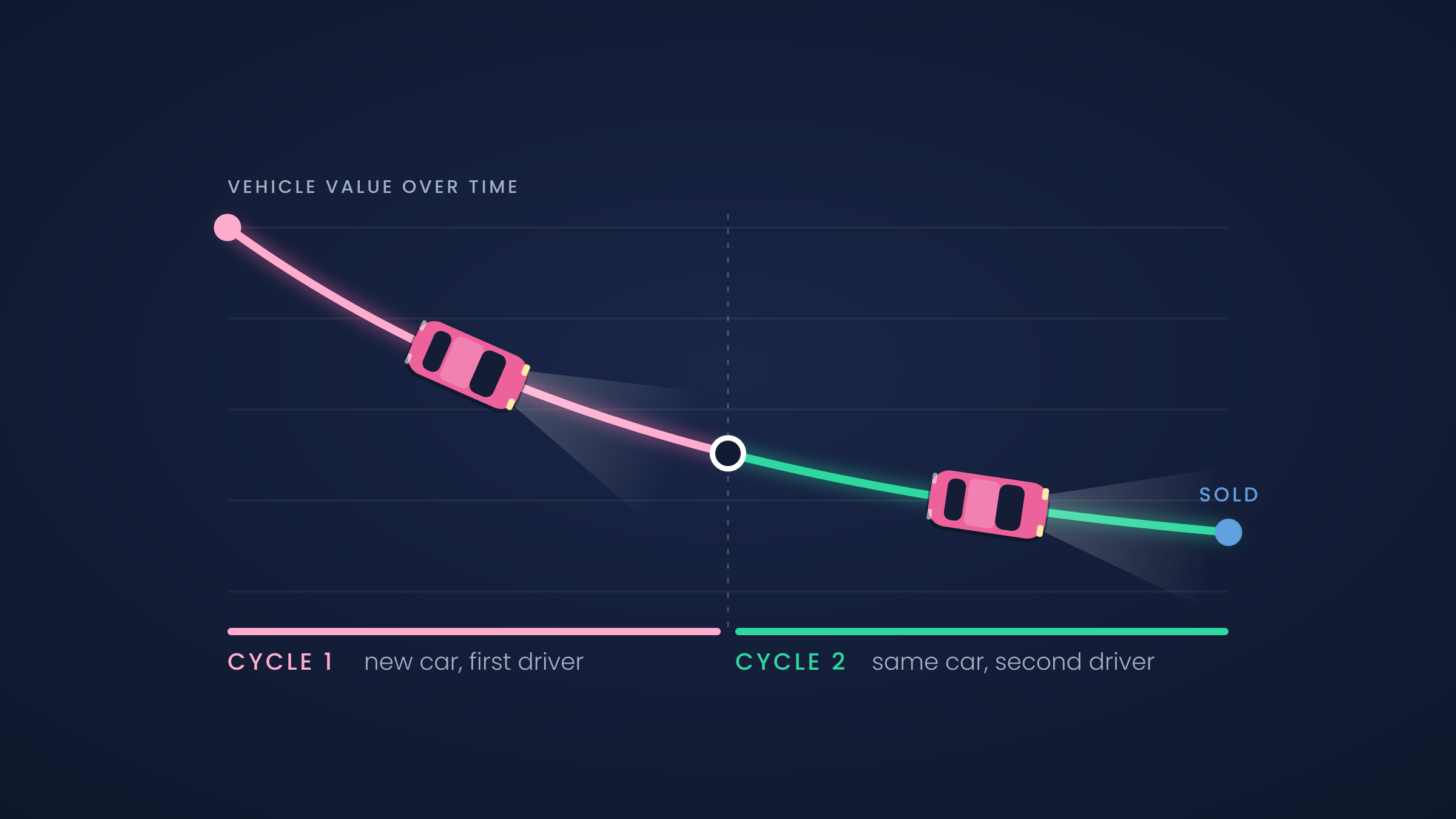
Since the pandemic, the inputs have moved. The trade used to pay more than the car was carried at, and now it often pays less. Drivers want used electric cars at the right monthly price: in Germany they now stand at the dealer for 74 days on average, against 84 for petrol and 92 for diesel, according to DAT. And a second contract is worth more than it looks. Keep the car and you avoid the gap between trade and retail price and the cost of remarketing. You get more months of margin from a car you have already sourced and funded. You also choose when to sell. And if you plan for two cycles from the start, the first contract no longer has to carry the whole early fall in value. That is how the €125 from the example above can come off again.
It is not free. Capital is tied up for longer. An older car costs more in service and may be out of warranty. And the residual value of a six- or seven-year-old electric car is something nobody has much data on yet. All of that counts against keeping the car.
The objection I hear most is that an electric car ages faster than a petrol one, so keeping it longer only adds risk. I think that is half right. What the buyer of a used electric car fears is owning it: the battery, and the next model being better. A lease takes that fear away, which makes the lessor a more natural owner of the car's second life than a private buyer is. The batteries themselves are holding up. Aviloo has compiled about 500,000 health tests, and at 150,000 kilometres most popular models still have 90 per cent or more of their capacity.
Ayvens has reached the same conclusion. Its plan to 2029 has used-car leasing growing to more than 100,000 cars, with margins above those on new leases. More than 60 per cent of those customers are new to the company, which should calm anyone worried that a used lease takes the place of a new one.
Why it still does not happen
If keeping is so often the better case, why are most returns still sold in the week they come back? I see two reasons.
One is how people are paid. In most companies, new and used are separate units with separate budgets. Sales are rewarded for new registrations. Remarketing is measured on days to sell and on price against the guide. Nobody is paid for what a car earns over its whole life, so nobody is asked whether to keep or sell.
The other is the system. Most leasing systems tie one car to one contract. A second contract on the same car, with a new customer, a new price and a shorter term, is not what they were built for. That does not have to mean replacing the system. I wrote about that in You Don't Close a Road to Add a Lane.
How we do it
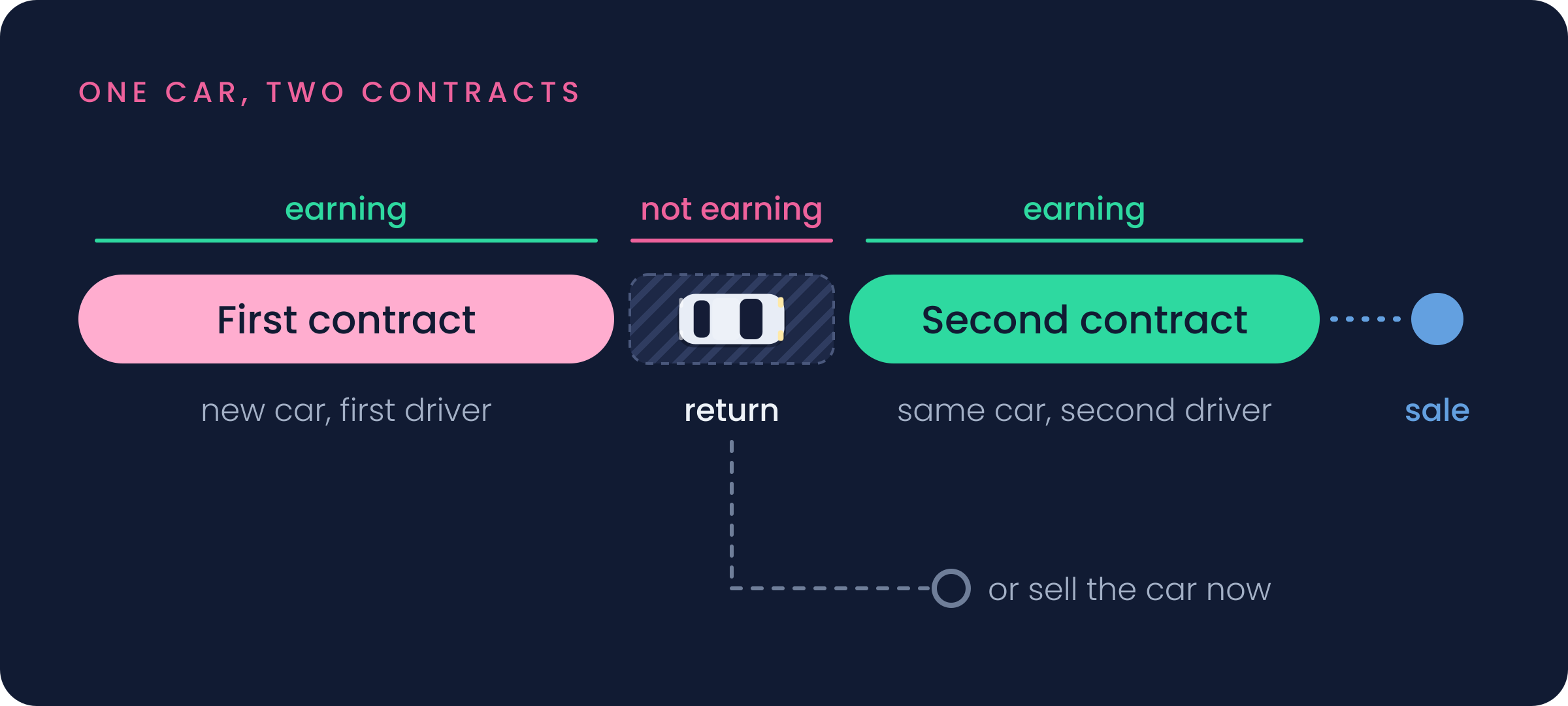
The logic is simple. Every car has two business cases, keep or sell, and you pick the better one.
Doing it is harder. To compare the two for a single car you need the contract and what it allows, since some cars are tied to a buy-back. You need what the car has earned and what is left to write down, its mileage and condition, the cost of turning it around, what the market pays this week for that model at that age, how quickly it would find a new driver, and what you know about the customer who has it now. On our platform that is dozens of data sources for each car. They sit in different systems, some of them outside the company, and several change every day.
An analyst with a spreadsheet can do this for one car. Nobody can do it by hand for a few thousand, and again every time the market moves. That is what we have spent our years on.
The comparison is the easy part. Having every input for every car in one place and up to date, so the comparison runs by itself, is the work.
On Casi it starts 90 to 120 days before the car is due back. Mileage comes from telematics, which is standard on all but a few cars on the platform. A second cycle is the right call when selling would mean a loss, or when keeping the car is simply the better business, and when somebody wants the car. Then we decide how long to extend, calculate a new price and offer the car, to the driver who has it or to a new one. Because this happens months before the return, there are few days between the two contracts.
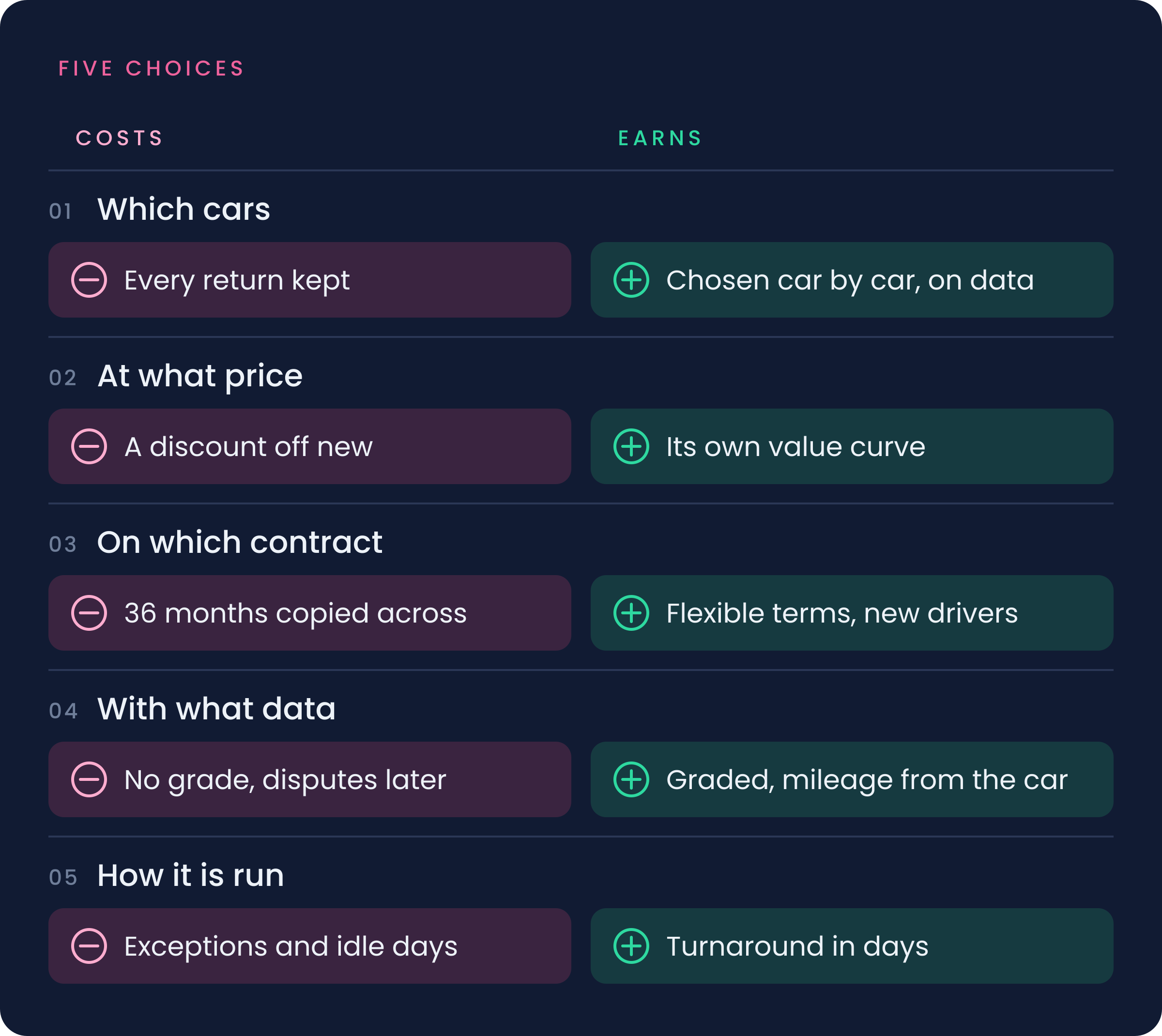
What makes it pay is mostly practical. The cars are chosen one by one. The used car is priced on its own value curve, and a discount on the new-car rate will not do. The contract is shorter and more flexible than the first. Fashion calls second-hand pre-loved, which is a little sweet for a leasing contract, but the instinct is right: the second driver should get a product of their own.
Of all the cars on the Casi platform, 38 per cent have gone on to a second customer and 23 per cent to a third or more. Many of those are flexible contracts, shorter than a classic lease. In our own operation in Norway it is eight in ten.
Always selling is the risky choice
The default for a returning lease car has been to sell it. That can still work. In the worst case it can end the business. Onto, which ran 7,000 electric cars on subscription in Britain, went into administration in 2023, and the first cause its administrators named was the fall in residual values.
For most of the cars coming back now, I would call a default sale the risk-seeking strategy. A second cycle is a way to manage residual value risk, which is one of the largest risks in this industry. With the right technology you can do it car by car, at scale.
If you want to see it done on your own returns, contact me.